
Technical Analyst Agent™ – Automated Market Intelligence for Chart Analysis, Indicators & Price Action
January 26, 2026
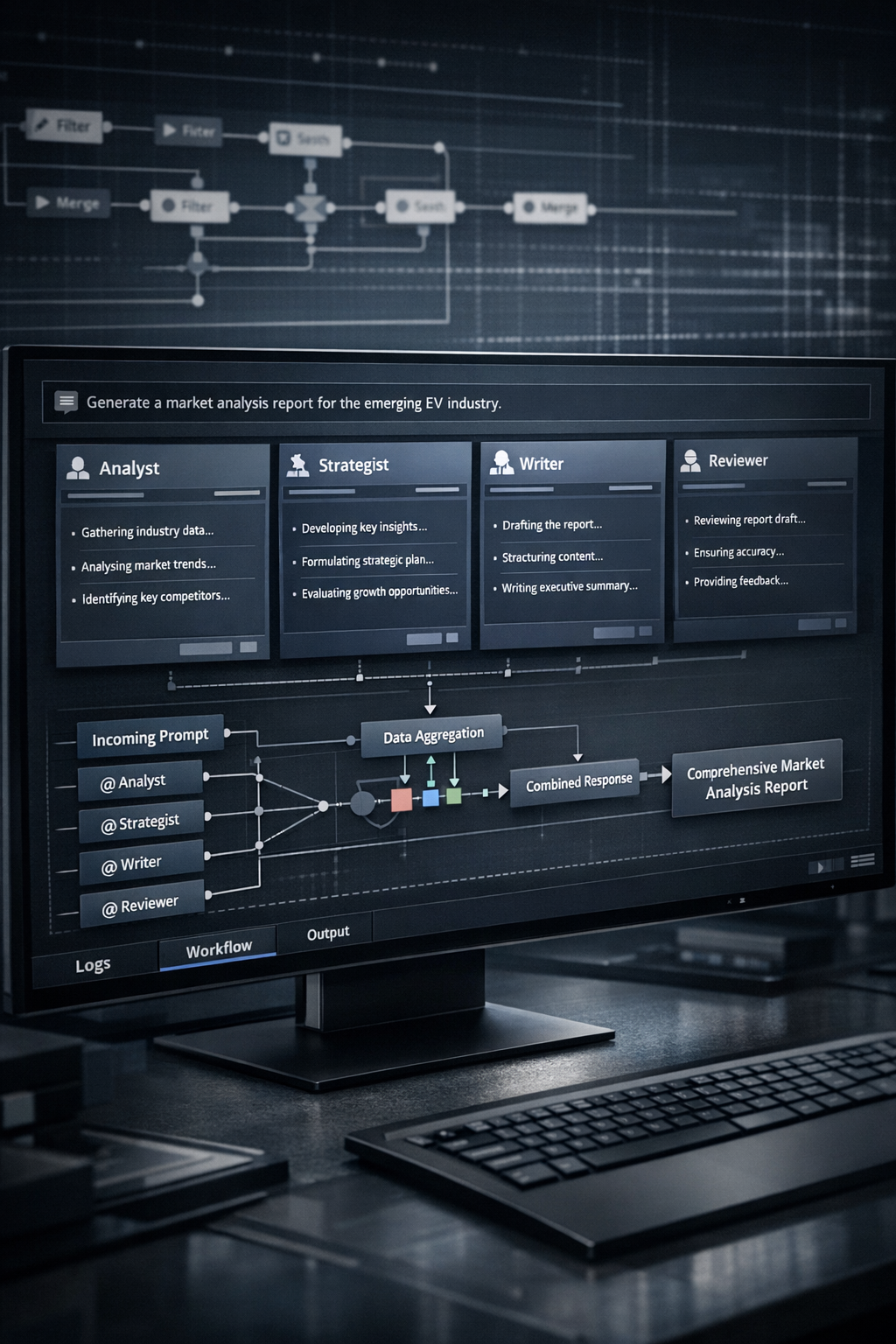
As artificial intelligence matures, single-agent systems are increasingly becoming a constraint rather than an advantage. Complex problems rarely have a single dimension, and expecting one model to reason, create, verify, and decide simultaneously introduces limitations in quality, scalability, and reliability.
The next evolution is multi-agent AI systems — architectures where multiple specialized AI agents collaborate, challenge each other, and contribute distinct perspectives toward a shared outcome.
This guide explains how multi-agent AI conversations work, why they outperform monolithic agents, and how they can be deployed today using a production-ready n8n workflow.
A multi-agent AI system is composed of several autonomous agents, each configured with a specific role, instruction set, and potentially even a different underlying language model. Instead of one generalized assistant, the system functions as a coordinated team.
Each agent focuses on what it does best:
reasoning and analysis
creative generation
verification and validation
strategic thinking
The result is a collaborative intelligence layer that mirrors how high-performing human teams operate.
Each agent is explicitly configured for a narrow responsibility. This allows deeper reasoning, clearer outputs, and higher precision than a single generalized model attempting to handle everything at once.
Capabilities scale by adding agents, not complexity. New expertise can be introduced without retraining or restructuring the entire system.
Because intelligence is distributed, the system does not rely on a single point of failure. If one agent underperforms, others can compensate or challenge its output.
By collecting responses from multiple agents, the system can simulate debates, reviews, brainstorming sessions, or adversarial analysis — producing more robust and well-rounded results.
While building a multi-agent system from scratch requires significant engineering effort, n8n makes this architecture accessible through structured automation.
The Multi-Agent Conversation AI Agent is a pre-configured n8n workflow designed to orchestrate multiple AI agents in a single conversational system.
All agents are defined in a single configuration layer. For each agent, you specify:
name and role
system instructions (persona)
underlying language model (via OpenRouter or similar)
This creates a transparent and maintainable setup.
Users can direct prompts to a specific agent by using @mentions (e.g. @Analyst, @Writer). The workflow parses the input and routes the request to the appropriate agent automatically.
This enables precise control over which expertise is engaged.
When no @mention is provided, the prompt is broadcast to all agents. Their responses are gathered, structured, and returned as a combined output — giving immediate access to multiple perspectives.
All agents operate with access to shared conversation history. This ensures continuity, prevents repetitive questioning, and allows agents to build on each other’s reasoning across multiple turns.
One agent drafts content, another edits for clarity, and a third optimizes for SEO or audience alignment.
Code generation, test creation, and issue detection can be handled by separate agents working in parallel.
Market analysis, strategic planning, and risk evaluation can be assigned to distinct agents to stress-test assumptions and uncover blind spots.
Requests can be triaged, resolved, and communicated by different agents — improving accuracy and response quality.
Multi-agent AI conversations shift AI from a reactive tool to an operational system. Instead of asking one model for an answer, you orchestrate a structured dialogue between specialists — improving output quality, reliability, and decision confidence.
With the Multi-Agent Conversation workflow for n8n, this architecture becomes practical, extensible, and production-ready — without custom infrastructure or complex orchestration logic.
👉 Get Started Now
 Shopify Order Processor™ – AI-Powered Post-Purchase Automation for CRM, Billing & Email Campaigns
Original price was: $990.00.$77.00Current price is: $77.00.
Shopify Order Processor™ – AI-Powered Post-Purchase Automation for CRM, Billing & Email Campaigns
Original price was: $990.00.$77.00Current price is: $77.00.
 Agentic RAG AI Agent™ – AI Agent for Knowledge Automation, Intelligent Document Querying & Advanced Data Analysis
Original price was: $649.00.$97.00Current price is: $97.00.
Agentic RAG AI Agent™ – AI Agent for Knowledge Automation, Intelligent Document Querying & Advanced Data Analysis
Original price was: $649.00.$97.00Current price is: $97.00.
 TikTok Caption Engine™ – Bulk Upload Automation Framework
Original price was: $117.00.$57.00Current price is: $57.00.
TikTok Caption Engine™ – Bulk Upload Automation Framework
Original price was: $117.00.$57.00Current price is: $57.00.
 HR & IT Helpdesk Agent™ – AI Agent for Automated Policy Support, Voice Transcription & Intelligent Chat Assistance
Original price was: $916.00.$79.00Current price is: $79.00.
HR & IT Helpdesk Agent™ – AI Agent for Automated Policy Support, Voice Transcription & Intelligent Chat Assistance
Original price was: $916.00.$79.00Current price is: $79.00.
 AI Agent Setup Service™ – Expert Implementation & Environment Configuration for n8n AI Agents
Original price was: $2,497.00.$997.00Current price is: $997.00.
AI Agent Setup Service™ – Expert Implementation & Environment Configuration for n8n AI Agents
Original price was: $2,497.00.$997.00Current price is: $997.00.
 YouTube Repurposing Engine™ – Automated Blog Conversion Blueprint
Original price was: $227.00.$137.00Current price is: $137.00.
YouTube Repurposing Engine™ – Automated Blog Conversion Blueprint
Original price was: $227.00.$137.00Current price is: $137.00.
 TikTok Intel System™ – Automated Data Extraction Blueprint
Original price was: $257.00.$147.00Current price is: $147.00.
TikTok Caption Engine™ – Bulk Upload Automation Framework
Original price was: $117.00.$57.00Current price is: $57.00.
TikTok Intel System™ – Automated Data Extraction Blueprint
Original price was: $257.00.$147.00Current price is: $147.00.
TikTok Caption Engine™ – Bulk Upload Automation Framework
Original price was: $117.00.$57.00Current price is: $57.00.
 DM Sales Engine™ – High-Converting Lead Message Framework
Original price was: $127.00.$67.00Current price is: $67.00.
DM Sales Engine™ – High-Converting Lead Message Framework
Original price was: $127.00.$67.00Current price is: $67.00.
 InvoiceFlow™ – Automated Billing & Invoice Management System
Original price was: $287.00.$167.00Current price is: $167.00.
Shopify Order Processor™ – AI-Powered Post-Purchase Automation for CRM, Billing & Email Campaigns
Original price was: $990.00.$77.00Current price is: $77.00.
Agentic RAG AI Agent™ – AI Agent for Knowledge Automation, Intelligent Document Querying & Advanced Data Analysis
Original price was: $649.00.$97.00Current price is: $97.00.
TikTok Caption Engine™ – Bulk Upload Automation Framework
Original price was: $117.00.$57.00Current price is: $57.00.
HR & IT Helpdesk Agent™ – AI Agent for Automated Policy Support, Voice Transcription & Intelligent Chat Assistance
Original price was: $916.00.$79.00Current price is: $79.00.
AI Agent Setup Service™ – Expert Implementation & Environment Configuration for n8n AI Agents
Original price was: $2,497.00.$997.00Current price is: $997.00.
YouTube Repurposing Engine™ – Automated Blog Conversion Blueprint
Original price was: $227.00.$137.00Current price is: $137.00.
TikTok Intel System™ – Automated Data Extraction Blueprint
Original price was: $257.00.$147.00Current price is: $147.00.
TikTok Caption Engine™ – Bulk Upload Automation Framework
Original price was: $117.00.$57.00Current price is: $57.00.
DM Sales Engine™ – High-Converting Lead Message Framework
Original price was: $127.00.$67.00Current price is: $67.00.
InvoiceFlow™ – Automated Billing & Invoice Management System
Original price was: $287.00.$167.00Current price is: $167.00.
InvoiceFlow™ – Automated Billing & Invoice Management System
Original price was: $287.00.$167.00Current price is: $167.00.
Shopify Order Processor™ – AI-Powered Post-Purchase Automation for CRM, Billing & Email Campaigns
Original price was: $990.00.$77.00Current price is: $77.00.
Agentic RAG AI Agent™ – AI Agent for Knowledge Automation, Intelligent Document Querying & Advanced Data Analysis
Original price was: $649.00.$97.00Current price is: $97.00.
TikTok Caption Engine™ – Bulk Upload Automation Framework
Original price was: $117.00.$57.00Current price is: $57.00.
HR & IT Helpdesk Agent™ – AI Agent for Automated Policy Support, Voice Transcription & Intelligent Chat Assistance
Original price was: $916.00.$79.00Current price is: $79.00.
AI Agent Setup Service™ – Expert Implementation & Environment Configuration for n8n AI Agents
Original price was: $2,497.00.$997.00Current price is: $997.00.
YouTube Repurposing Engine™ – Automated Blog Conversion Blueprint
Original price was: $227.00.$137.00Current price is: $137.00.
TikTok Intel System™ – Automated Data Extraction Blueprint
Original price was: $257.00.$147.00Current price is: $147.00.
TikTok Caption Engine™ – Bulk Upload Automation Framework
Original price was: $117.00.$57.00Current price is: $57.00.
DM Sales Engine™ – High-Converting Lead Message Framework
Original price was: $127.00.$67.00Current price is: $67.00.
InvoiceFlow™ – Automated Billing & Invoice Management System
Original price was: $287.00.$167.00Current price is: $167.00.


